Roof Pitch Calculator: Check a Rounded Result
Keep the original rise and horizontal run beside every rounded pitch result. Recalculate from that source pair; do not treat a displayed ratio, degree, or percentage as a new field measurement.
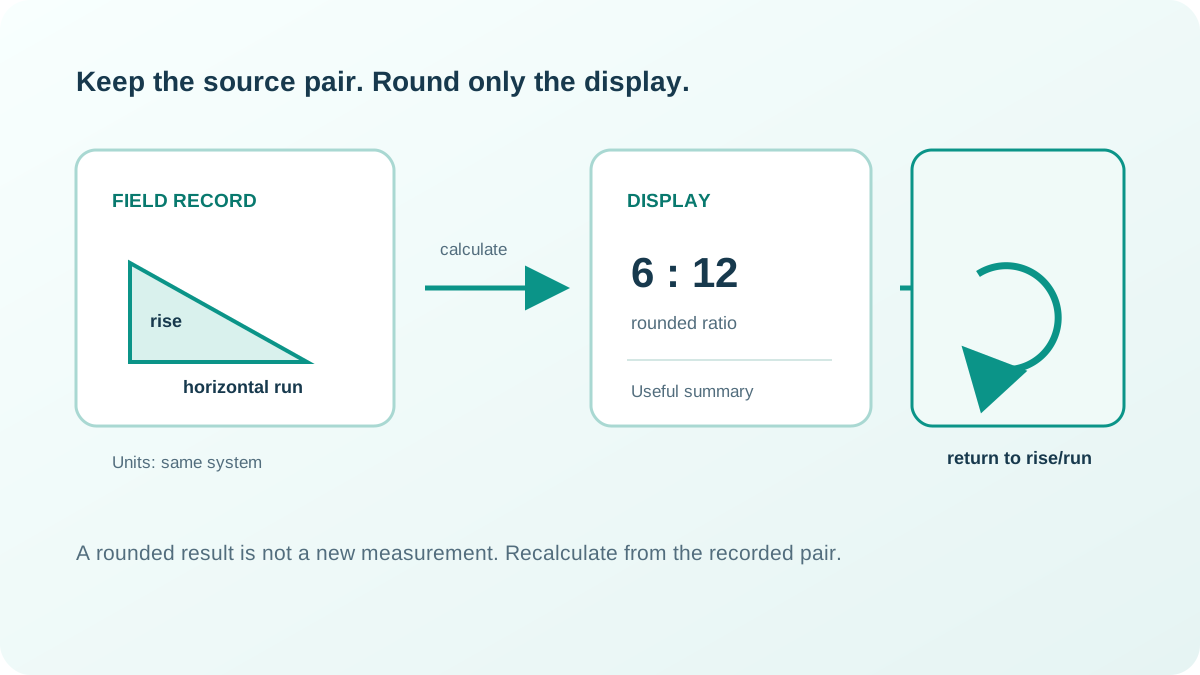
Record the input pair first
A roof-pitch calculator transforms one vertical rise and one horizontal run. Those two values are the useful record because they identify the triangle that was measured. A result such as a ratio, angle, or percentage is derived from that pair.
Rounding can make a displayed result easier to read, but it removes detail. When a later note only says “about 6:12” or “roughly 27°,” it no longer shows the exact pair that was entered or whether the two measurements used the same units.
Keep rise and horizontal run with their units and the roof plane they describe.
Label a ratio, degree, or percent as a calculated display—not a replacement measurement.
When checking later, enter the original pair again instead of reversing a rounded result.
Why reverse-calculating a rounded display can drift
A rounded display represents a range of nearby values rather than one exact measurement. If you convert that display back into a new rise or run, you may create a different triangle from the one first measured. The difference can be small, but the new number should not silently replace the source record.
That does not make a rounded result useless. It is a convenient summary for conversation, drawings, or a quick comparison. The check is simply to preserve the measured pair separately whenever the exact input matters.
A practical field-note format
Rise: ___ Run: ___ Units: ___
Ratio: ___ Degrees: ___ Date checked: ___
Add a short label such as “one-plane horizontal run” if there is any chance a future reader could confuse it with full span. That label protects the input record without asking the result to carry more precision than it displays.
A repeatable calculator check confirms the entered triangle. It does not verify site dimensions, roof symmetry, framing layout, material suitability, or any project approval.
Can I use a rounded pitch result to recreate the original measurement?
Not exactly. Use the original rise and horizontal run if they are available. A rounded result is a summary of the calculation and may not reconstruct the exact field pair that produced it.
Method and scope
- Original calculator logic: pitch values are derived from a rise-and-horizontal-run input pair. This page provides a recordkeeping method and does not introduce construction limits or product claims.
This is an original calculator-record guide, not a structural layout or construction approval.