Roof Peak Calculator: Find Ridge Height from Span and Pitch
For a centered, symmetrical gable, divide the full span by two, then multiply that horizontal run by the pitch rise ÷ 12. The result is the ridge height above the reference line used for the run—not a complete framing or cut-layout instruction. First confirm that the ridge is centered and that your span and pitch describe the same roof plane.
Calculate pitch from a measured rise and run
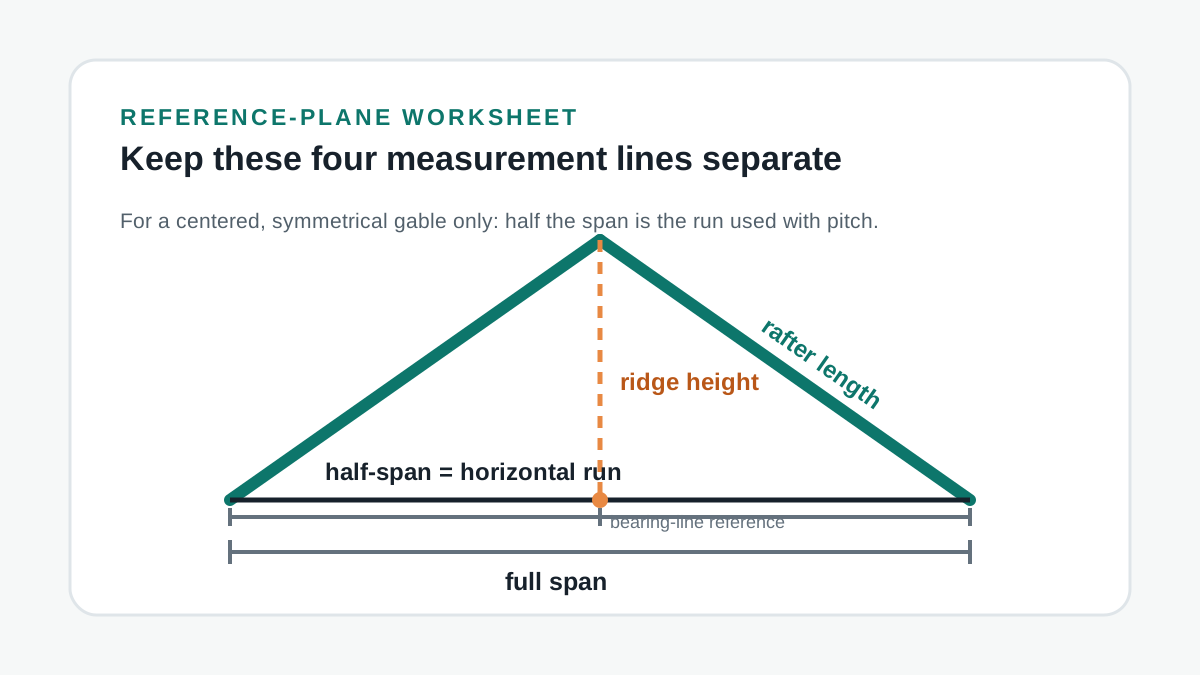
Start by naming the reference line
A roof peak is a vertical distance above a chosen horizontal reference line. On a centered symmetrical gable, the two roof planes mirror one another, so one roof plane's horizontal run is half the full span. That condition is an assumption to verify from the drawing or field measurement; an offset ridge, different eave heights, an overhang, or an irregular plan calls for the actual roof-plane measurements instead.
| Label | Measurement line | Use in this worksheet |
|---|---|---|
| Full span | Horizontal distance across both roof planes, from the selected left endpoint to the selected right endpoint | Divide by two only after confirming a centered, symmetrical gable. |
| Horizontal run | Level distance from one roof-plane start to the centered ridge line | Use this as the run in the pitch calculation. |
| Ridge height | Vertical distance from the same reference line up to the ridge | This is the rise result. |
| Rafter length | Sloped diagonal from the roof-plane start to the ridge | Check separately; do not substitute it for run. |
The peak calculation
With matching units, use run = span ÷ 2 and ridge height = run × (pitch rise ÷ 12). The ratio is a right-triangle relationship: the rise is opposite the roof angle and the run is adjacent. OpenStax defines tangent as opposite divided by adjacent, and its right-triangle material gives the Pythagorean relationship for a later diagonal check.1, 2
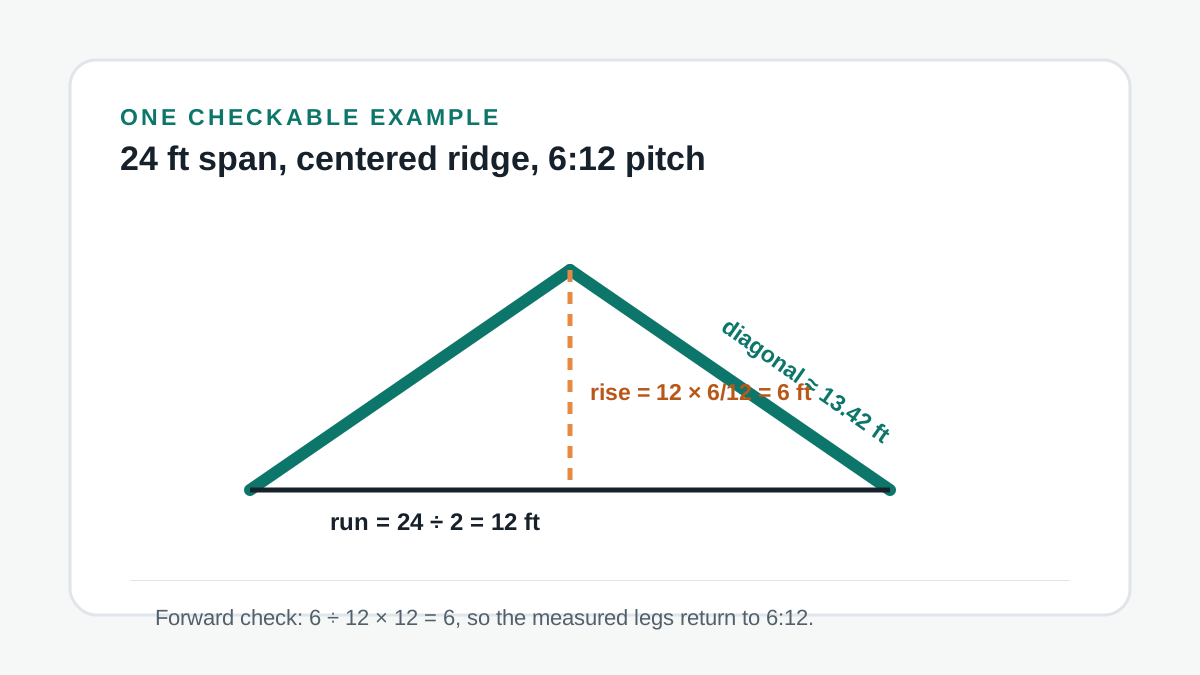
Example: A 24 ft full span with a centered ridge gives a 12 ft run. At 6:12, the ridge height above the reference line is 12 × (6 ÷ 12) = 6 ft. A forward check gives (6 ÷ 12) × 12 = 6, returning the stated 6:12 pitch.
Use the diagonal only as a separate geometry check
For the example above, the two legs are 12 ft and 6 ft. The Pythagorean theorem gives the diagonal as √(12² + 6²), about 13.42 ft. That result describes the idealized triangle shown here. It is not a rafter cutting dimension and does not account for ridge-board, birdsmouth, overhang, member sizing, or structural requirements.
Can a roof peak calculator find the ridge height from any building width?
No—only use half the building width when the measured roof plane is a centered, symmetrical gable and the chosen endpoints match the stated span. For an offset ridge or unequal roof planes, calculate each plane from its own horizontal run and reference line. A calculator can check the geometry; it cannot establish the framing layout or approval requirements.
Before using the number on a project
- Mark the horizontal reference line and the two endpoints that define the span.
- Confirm the ridge is centered and the two roof planes are symmetrical before halving the span.
- Keep the pitch's rise and the run in matching units.
- Return-check the calculated rise back to x:12.
- Keep framing cuts, member sizing, roof covering, and local requirements as separate decisions.
Sources
- OpenStax, “Right Triangle Trigonometry” — defines tangent as the opposite side divided by the adjacent side.
- OpenStax, “Right Triangle Trigonometry” — states the Pythagorean theorem for the two legs and hypotenuse of a right triangle.
The figures and worked calculations are original geometry explanations. They are not construction drawings, structural design, or material-selection advice.