Flashing Minimum Pitch: Check the Product Datasheet
Do not derive a flashing minimum pitch from roof geometry alone. Treat it as a product-specific limit, then confirm the named product, roof detail, substrate, and installation instructions. For example, Klober lists a 10° minimum pitch for its EasyForm lead-free flashing—not a universal minimum for every flashing system.
Use the roof pitch calculator for the measurement, not the approval
Start by recording the actual roof-plane rise and horizontal run. The roof pitch calculator can convert those inputs into a ratio, degrees, and percent. That gives you a measurement to compare with a datasheet; it does not select a flashing product or confirm that an installation detail is suitable.
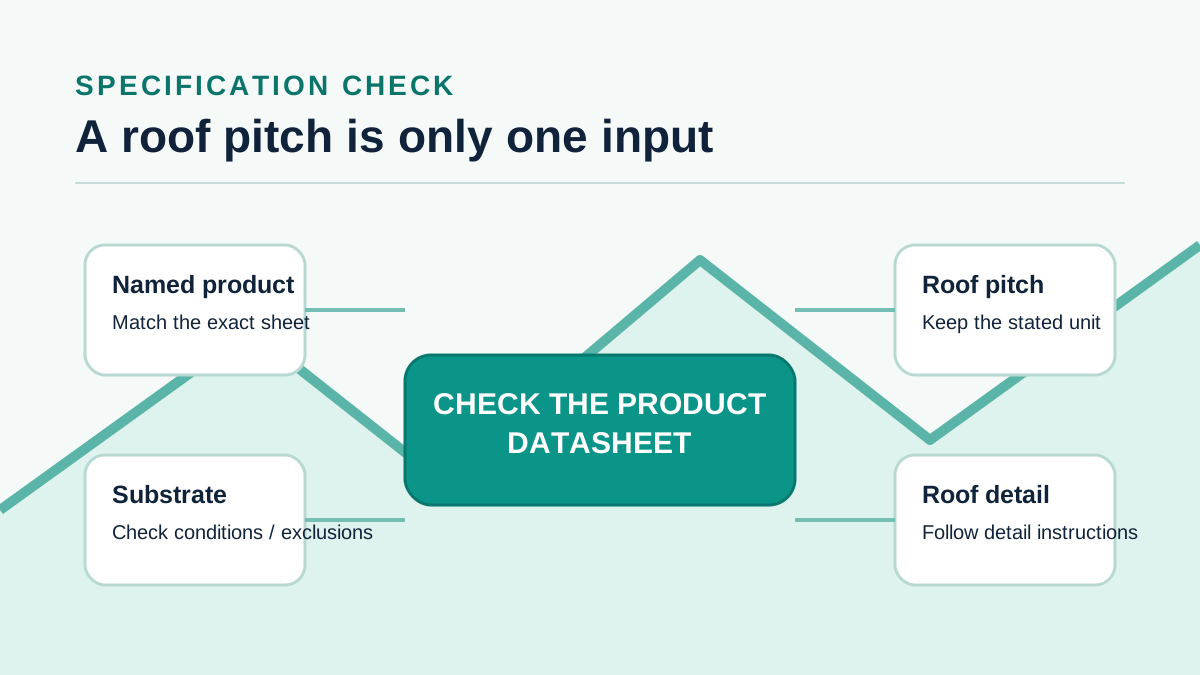
Read four items together
Use the exact product and current technical document. Similar-looking flashing materials can have different limits.
Keep the stated unit. If a sheet uses degrees, do not silently replace it with a 12-in-run ratio.
Check the surface conditions and exclusions stated by the maker before treating the pitch as relevant.
Abutment, valley, penetration, and edge details can have their own installation instructions.
A concrete, limited example
Klober’s EasyForm technical data sheet describes EasyForm as a lead-free flashing for pitched roofs and lists a minimum roof pitch of 10°. The same sheet says its butyl adhesive should be applied to suitable surfaces that are dry and dust-free, and that it is not suitable for bituminous roof coverings. Those statements belong to EasyForm; do not carry them over to an unnamed flashing product.
Its installation guide also treats overlap as pitch-sensitive for one horizontal top-edge-abutment detail: it shows a greater-than-150 mm overlap at 15° and above, and greater-than-200 mm from 12.5° to 15°, with a greater-than-75 mm vertical dimension in both illustrated rows. Use the guide only for that named product and detail, and check the complete instructions before work.
Does a pitch label make a flashing suitable?
No. A pitch label can be one valid input, but it does not answer whether the product matches the roof covering, substrate, detail, local requirements, or the rest of the installation system. When any of those details are unknown, keep the answer as “not confirmed.”
Sources and scope
- Klober EasyForm Technical Data Sheet — product-specific 10° minimum pitch, substrate conditions, and bituminous-covering exclusion.
- Klober EasyForm Installation Guide — pitch-dependent overlap illustration for the named horizontal top-edge-abutment detail.
This page explains how to read a specification. It is not a construction drawing, code interpretation, or approval for a project.