Rafter Pitch Calculator
Enter a stated pitch and horizontal run to calculate the matching rise and geometric diagonal. The diagonal checks a right-triangle model; it is not a rafter cut list or a framing-layout instruction.
Check one labelled roof triangle
Matching geometry
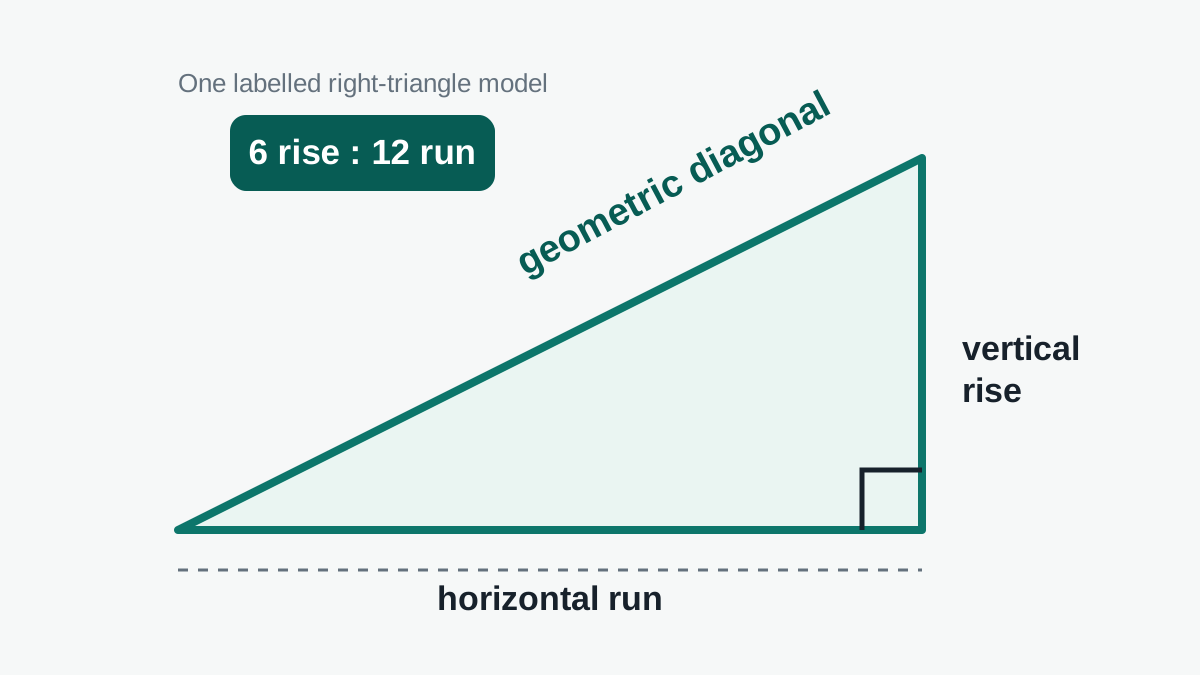
Start with the horizontal run
A pitch written as 6:12 means 6 units of vertical rise for every 12 horizontal units of run. For the same stated pitch, calculate the matching rise as run × pitch rise ÷ 12. With a 12-unit run and 6:12 pitch, that produces a 6-unit rise.
That rise-over-run relationship is the tangent ratio for a right triangle when the rise is opposite the angle and the horizontal run is adjacent to it.1 Keep both measurements in the same length unit before treating their ratio as one triangle.
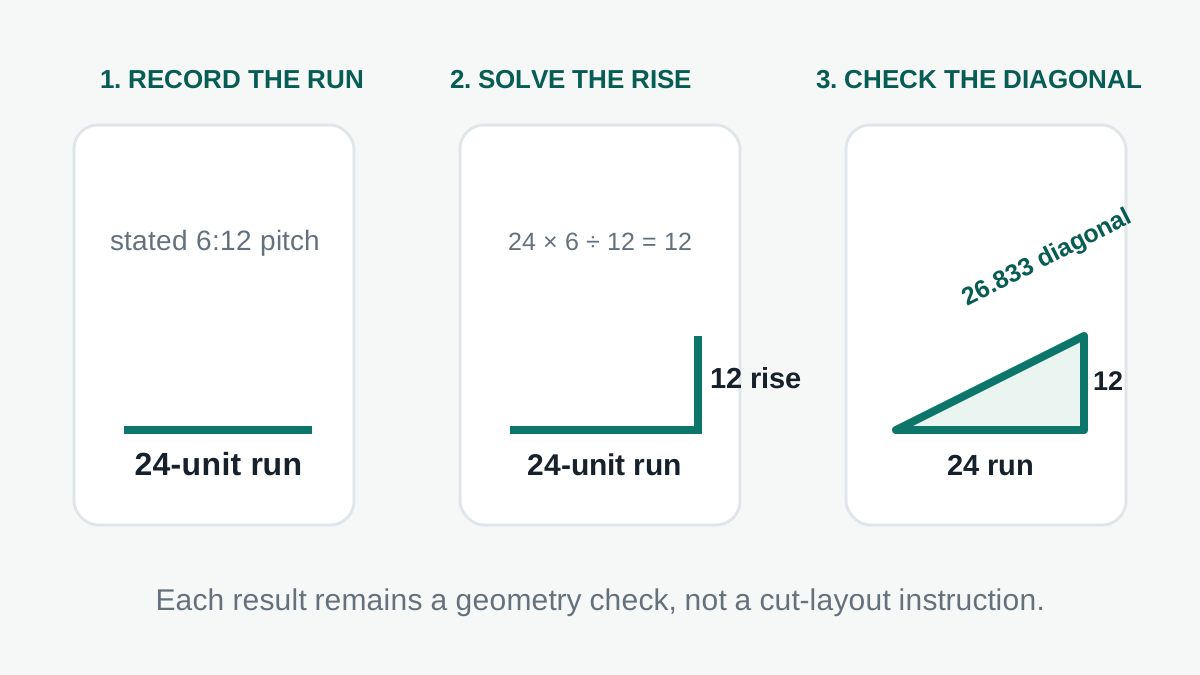
Check the diagonal after the two legs are known
For a right triangle, the Pythagorean theorem relates the two legs to the hypotenuse: diagonal = √(run² + rise²).2 A 12-unit run and 6-unit rise therefore give √(12² + 6²), approximately 13.416 units.
This is a geometric diagonal, not a cut-layout instruction. It does not establish bearing details, ridge treatment, member sizing, allowances, roof covering, or project requirements. Use the calculated triangle as a record to check, then keep those decisions in the relevant project documentation.
Can a rafter pitch calculator tell me how to cut a rafter?
No. It can check the run, rise, and geometric diagonal of a stated triangle, but it cannot define a rafter cut layout. Cut and bearing details require the project-specific framing decisions that the triangle alone does not contain.
Three-line rafter pitch check
- Write the stated pitch as its rise per 12 horizontal units and record one horizontal run.
- Calculate the matching rise from that same run.
- Use the two legs to check the geometric diagonal, without relabelling it as a cut or material decision.
Sources
- OpenStax, “Right Triangle Trigonometry” — defines tangent as opposite divided by adjacent.
- OpenStax, “Right Triangle Trigonometry” — presents the Pythagorean theorem for the legs and hypotenuse of a right triangle.
The diagrams and worked calculations are original geometry explanations, not construction drawings or project approvals.