Roof Pitch Calculator Metric: Measure in Millimetres, Then Check x:12
Measure vertical rise and horizontal run in the same metric unit, divide rise by run, then multiply that ratio by 12 to express the same slope as x:12. Do not divide millimetres by metres without converting one first: the calculation needs a unit-consistent pair.
Calculate a measured rise and run
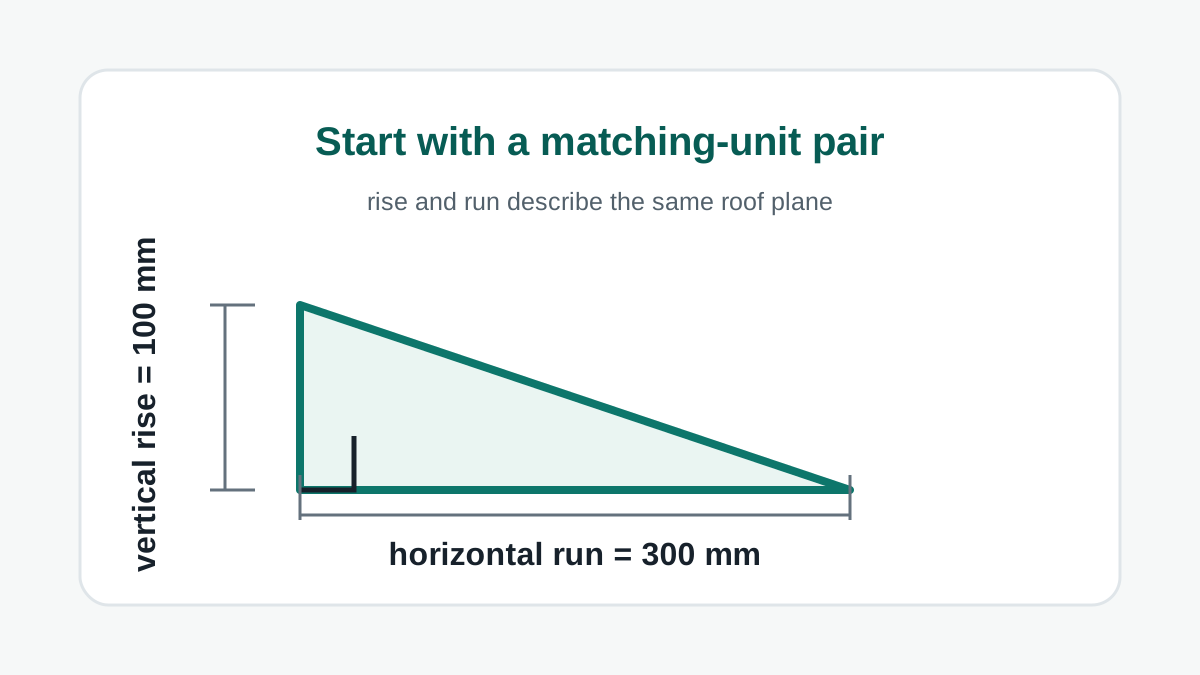
Use one unit for both measured lines
Pitch begins with a right-triangle ratio: vertical rise divided by horizontal run. OpenStax defines tangent in a right triangle as opposite divided by adjacent; in this worksheet, rise is the vertical leg and run is the horizontal leg.1 The metre is the SI base unit for length, and NIST’s SI guide lists millimetres as a prefixed form of that unit.2
If the rise is recorded in millimetres and the run in metres, convert one value so both describe the same length unit before dividing. The choice of millimetres, centimetres, or metres does not change a ratio when both entries are converted together; mixing them does.
A same-unit metric check
| Measurement record | Ratio calculation | x:12 check |
|---|---|---|
| Rise: 100 mm Horizontal run: 300 mm | 100 ÷ 300 = 1 ÷ 3 | (1 ÷ 3) × 12 = 4, so the same slope is 4:12. |
| Rise: 0.1 m Horizontal run: 0.3 m | 0.1 ÷ 0.3 = 1 ÷ 3 | The ratio returns the same 4:12 result. |
The two rows are a conversion check, not two different roof slopes. Each uses a matched pair, so each reduces to the same rise-over-run ratio.
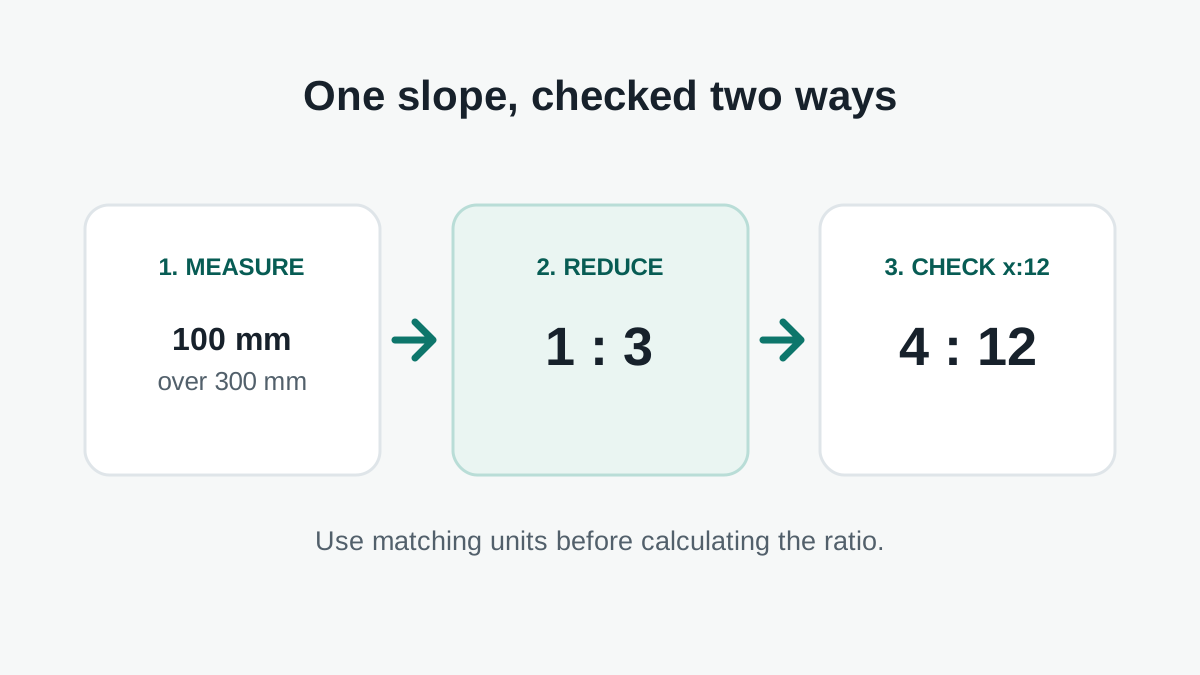
Can a roof pitch calculator use millimetres?
Yes—enter rise and horizontal run in millimetres when both measurements use millimetres. The calculator uses their ratio. If the two field notes use different units, convert one before entering either value; the calculator cannot determine whether mixed-unit inputs describe the same scale.
Keep geometry separate from project decisions
A pitch calculation describes the measured roof plane. It does not establish rafter-cut layout, structural member sizing, roof-covering suitability, drainage performance, or local approval requirements. Use the verified geometry as one input to those separate project decisions.
Three-line field record
- Write the vertical rise, its unit, and the points between which it was measured.
- Write the horizontal run, using the same unit and the corresponding roof-plane points.
- Reduce rise ÷ run, multiply by 12 for an x:12 cross-check, and retain the original metric pair.
Sources
- OpenStax, “Right Triangle Trigonometry” — defines tangent as the ratio of opposite to adjacent in a right triangle.
- National Institute of Standards and Technology, “SI Units” — identifies the metre as the SI unit of length and lists SI prefixes.
The diagrams and calculations on this page are original geometry explanations. They are not construction drawings or project approvals.