Roof Pitch Calculator Checklist
Before using a roof-pitch result, verify that the rise and run describe the same roof plane, the run is horizontal, both inputs use the same unit, and the displayed format matches the question you need answered.
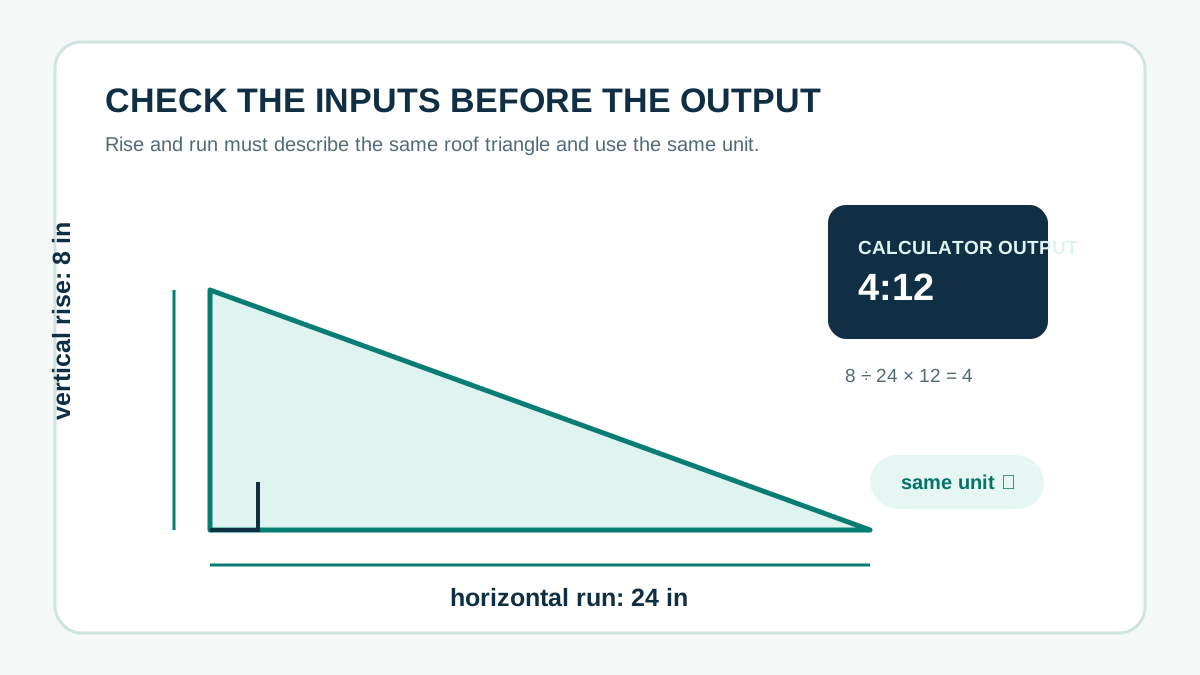
Five checks before you use a roof pitch calculator
- Name the roof plane. Record which slope you are measuring. Do not combine a rise from one plane with a run from another.
- Keep the run horizontal. Pitch is based on vertical rise over horizontal run, not on the sloped rafter length.
- Match the units. Use inches for both inputs, millimetres for both inputs, or convert before calculating.
- Choose the output you need. A pitch such as
4:12, a grade of33.333%, and an angle of about18.435°describe the same ratio in different formats. - Reverse-check the number. For a result of
4:12and a 24-inch horizontal run,24 × 4 ÷ 12 = 8; the expected rise is 8 inches.
Why rise and run must belong together
A roof-pitch calculation is right-triangle geometry. The ratio is rise ÷ run. Multiply that ratio by 12 to express pitch as rise per 12 horizontal units; multiply by 100 for percent grade; use the inverse tangent for degrees.1
For example, a vertical rise of 8 inches over a horizontal run of 24 inches gives 8 ÷ 24 = 0.333…. The equivalent pitch is 0.333… × 12 = 4:12, the grade is 0.333… × 100 = 33.333%, and the angle is atan(8 ÷ 24) ≈ 18.435°. The calculator does not determine whether the measurements were taken correctly; it only transforms the values entered.
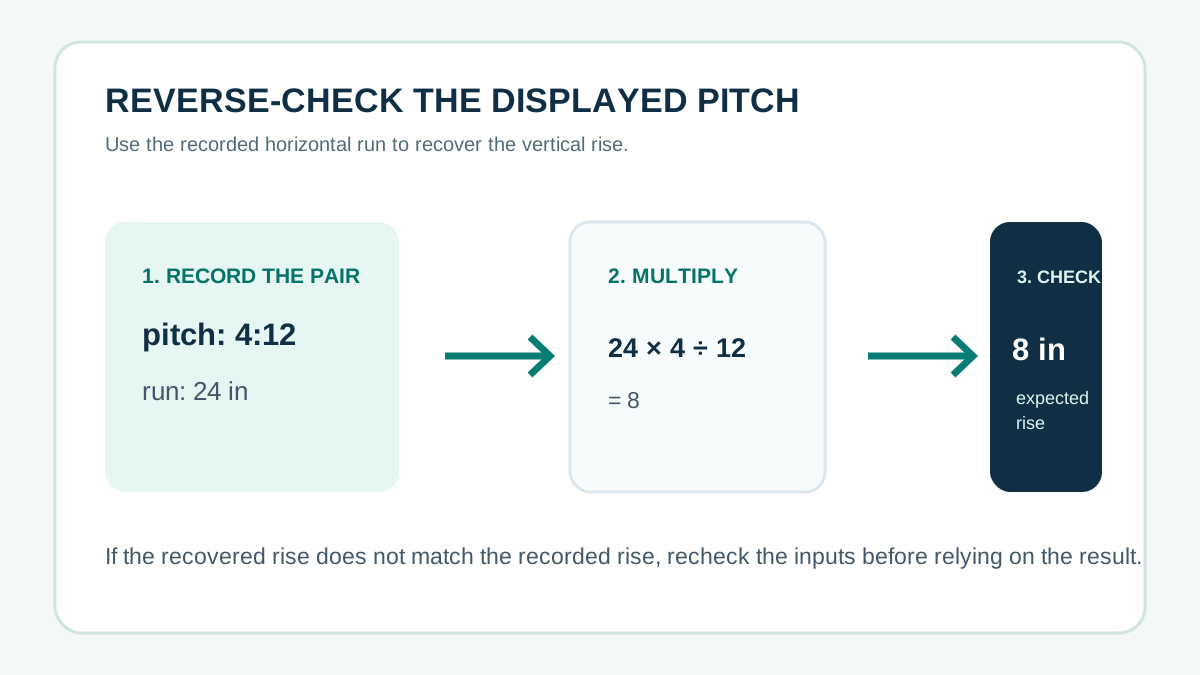
Can a roof pitch calculator replace a field measurement?
No. A calculator can convert a rise/run pair and show equivalent formats. It cannot confirm the roof plane, verify a cut, size framing, select materials, assess drainage, or approve a project. Take measurements safely and use the resulting pitch only as one input to the separate checks your project requires.
What to write down with the answer
Keep the original vertical rise, horizontal run, unit, roof-plane description, and date beside the converted result. That record lets you redo the arithmetic or find a mismatched unit later. If rise and run were recorded in different units, convert one value before dividing; NIST identifies the metre as the SI base unit for length and documents the SI prefixes used for decimal conversions.2
Sources
- OpenStax, “Right Triangle Trigonometry” — defines tangent in a right triangle as opposite divided by adjacent.
- National Institute of Standards and Technology, “SI Units” — describes SI base units and prefixes.
The diagrams are original geometry aids. They are not construction drawings, safety instructions, or project approvals.