Roof Pitch Estimator
Use an estimate only as a starting label. To check roof pitch, measure vertical rise over the same horizontal run, then convert that measured ratio to x:12, percent, and degrees.
Compare a first estimate with a measured pair
Use the recorded pair, not the first guess
Write the estimate and the measurement on separate lines
A first look from the ground, a plan note, or an app display can give you an initial pitch estimate. Keep that value separate from the field record. For the field check, place a level over a known horizontal distance, then measure the vertical gap at the far end. The two measurements must describe the same roof plane and use the same length unit.
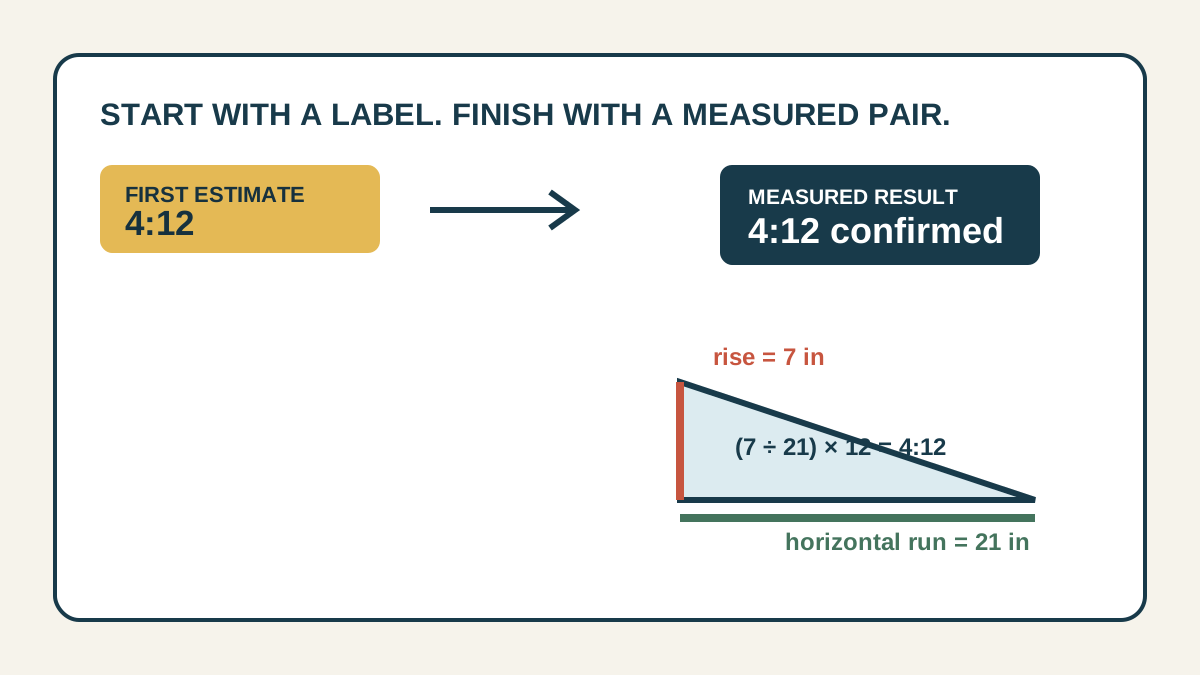
For example, an estimate of 4:12 can be checked with a rise of 7 inches over a horizontal run of 21 inches. The calculation is (7 ÷ 21) × 12 = 4, so the measured pair also reads 4:12. The same ratio is 33.333%, and atan(7 ÷ 21) ≈ 18.435°.1
A small field record you can repeat
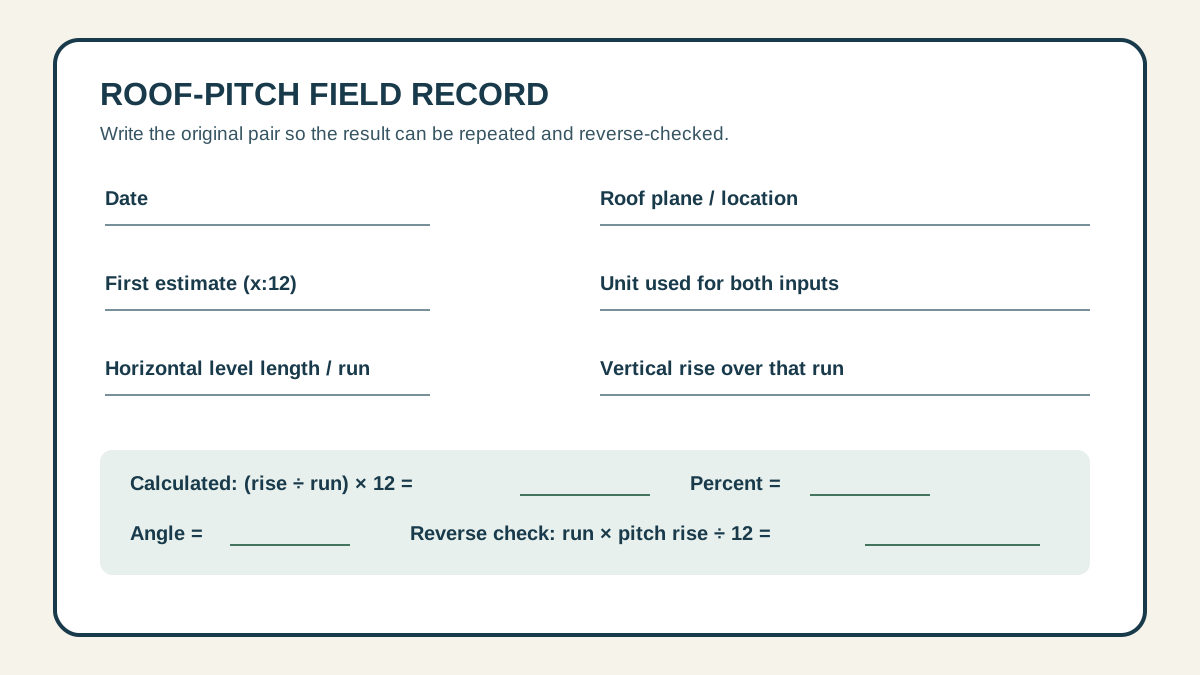
- Write the date and identify the roof plane being checked.
- Write the horizontal level length and the vertical rise measured over that exact length.
- Write the unit once, then use that same unit for both values.
- Calculate
(rise ÷ run) × 12for x:12 pitch,rise ÷ run × 100for percent, andatan(rise ÷ run)for degrees. - Reverse-check the result:
run × pitch rise ÷ 12should recover the recorded rise.
Keeping the original rise and run makes the result reproducible. NIST describes the metre as the SI base unit for length and documents SI prefixes; the practical rule here is simply to convert first whenever rise and run are not recorded in the same unit.2
Can a roof pitch estimator verify a roof system or framing cut?
No. It can compare an estimate with a measured roof triangle, but it cannot verify framing cuts, member sizing, drainage, product selection, fasteners, flashing, or project requirements. Use the measured pitch as one input to those separate checks, not as an approval.
When the estimate and measurement disagree
Do not average the two numbers. First recheck that the run was horizontal, that the rise was taken at the same end of that run, and that both values use the same unit. Then repeat the measurement on the same plane. A different roof plane, a different run length, or mixed units can produce a different-looking result without proving that either number is wrong.
Sources
- OpenStax, “Right Triangle Trigonometry” — explains tangent in a right triangle as opposite divided by adjacent.
- National Institute of Standards and Technology, “SI Units” — describes SI base units and prefixes.
The diagrams and worksheet are original geometry aids. They are not construction drawings or approvals.